Motion planning with contacts
Geometry- and topology-informed motion planning for continuum robots interacting with obstacles.
Continuum robots are inherently compliant and underactuated. Leveraging this feature, they can safely interact with the environment and leverage contacts to change shape without using extra actuators. This project focuses on developing efficient algorithms for motion planning that leverage environmental contacts for continuum robots.
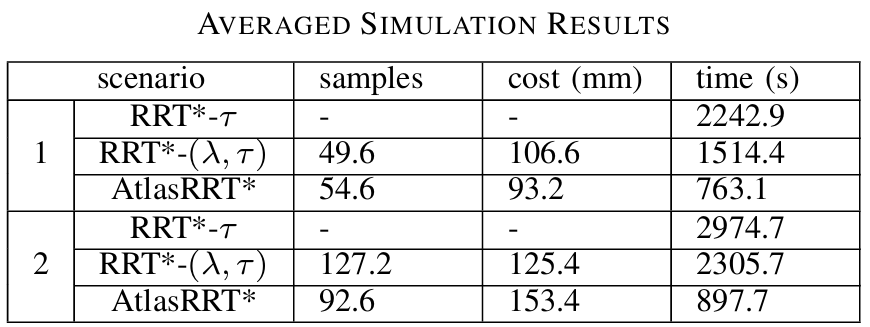
Contacts warp the configuration space of continuum robots, making it a low-dimensional manifold that is immersed in a high-dimensional ambient space. Therefore, direct Euclidean sampling in the ambient space is inefficient. I showed that, under conservative force fields that emulate elastic contacts, the configuration space is a smooth manifold that can be locally parameterized by the actuation inputs and base internal wrench. This permits using manifold planning algorithms for efficient sampling-based planning. I tested AtlasRRT, which outperforms Euclidean RRT on this task.
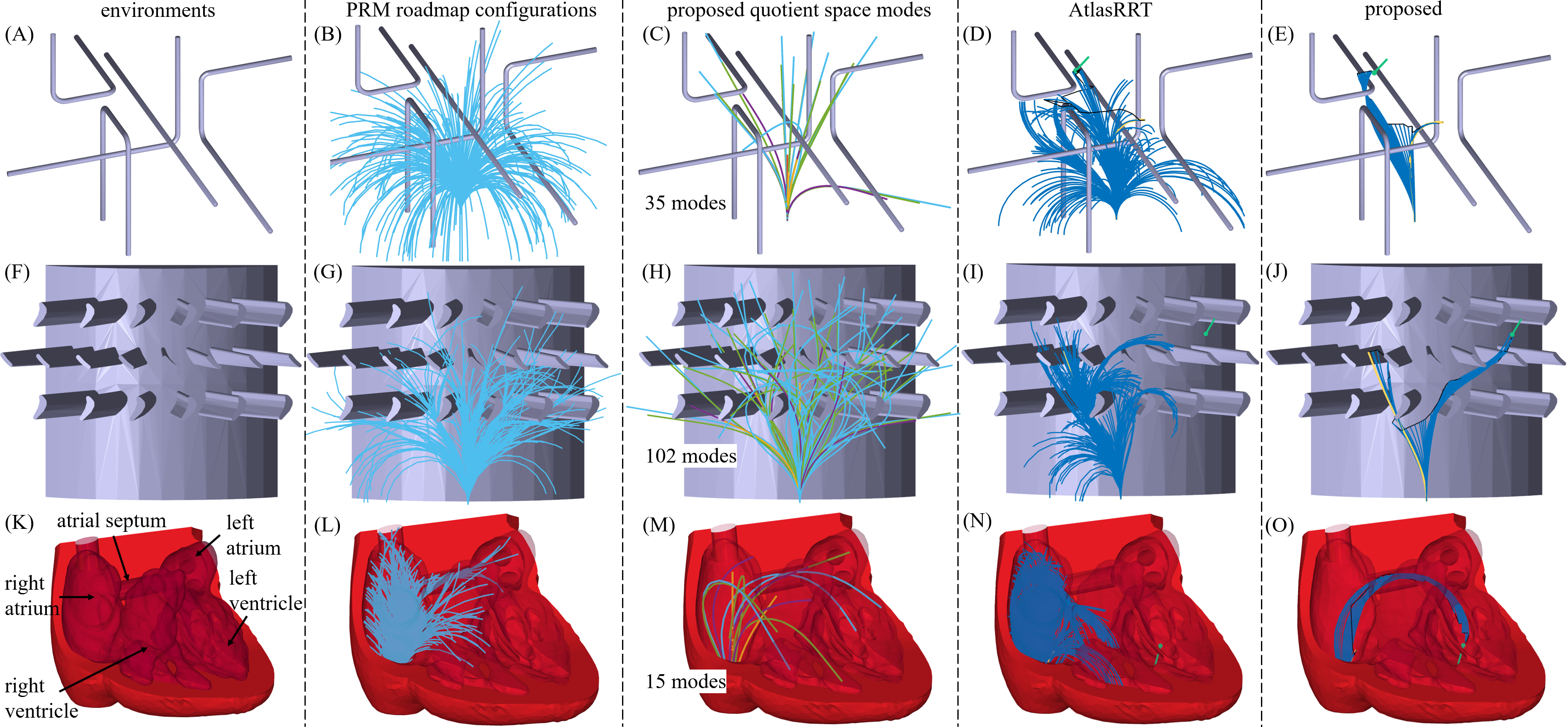
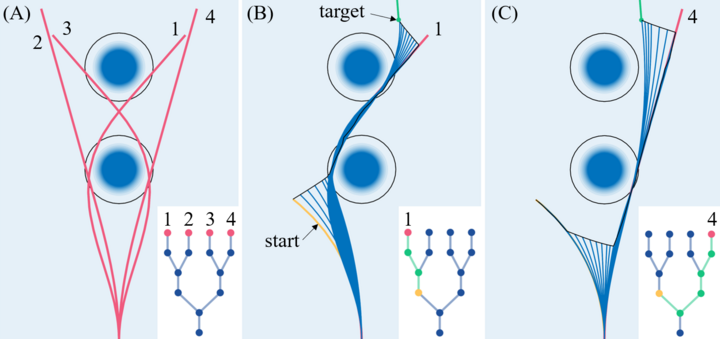
Furthermore, if we consider length-variable continuum robots, contact force fields can induce singularities/bifurcations in their configuration space. This naturally leads to topological structures that can be leveraged to restrict the scope of sampling. I found that a good way to represent this topology is constructing a quotient space structure. Its base space consists of all possible zero-actuation configurations in the given environment, and non-zero actuations at a certain robot length would span a fiber. We then obtain a piecewise 1-dimensional base space that serves as an abstraction of the configuration space topology or contact modes. Planning on this base space beforehand can significantly reduce the actual sampling needed to form a plan.
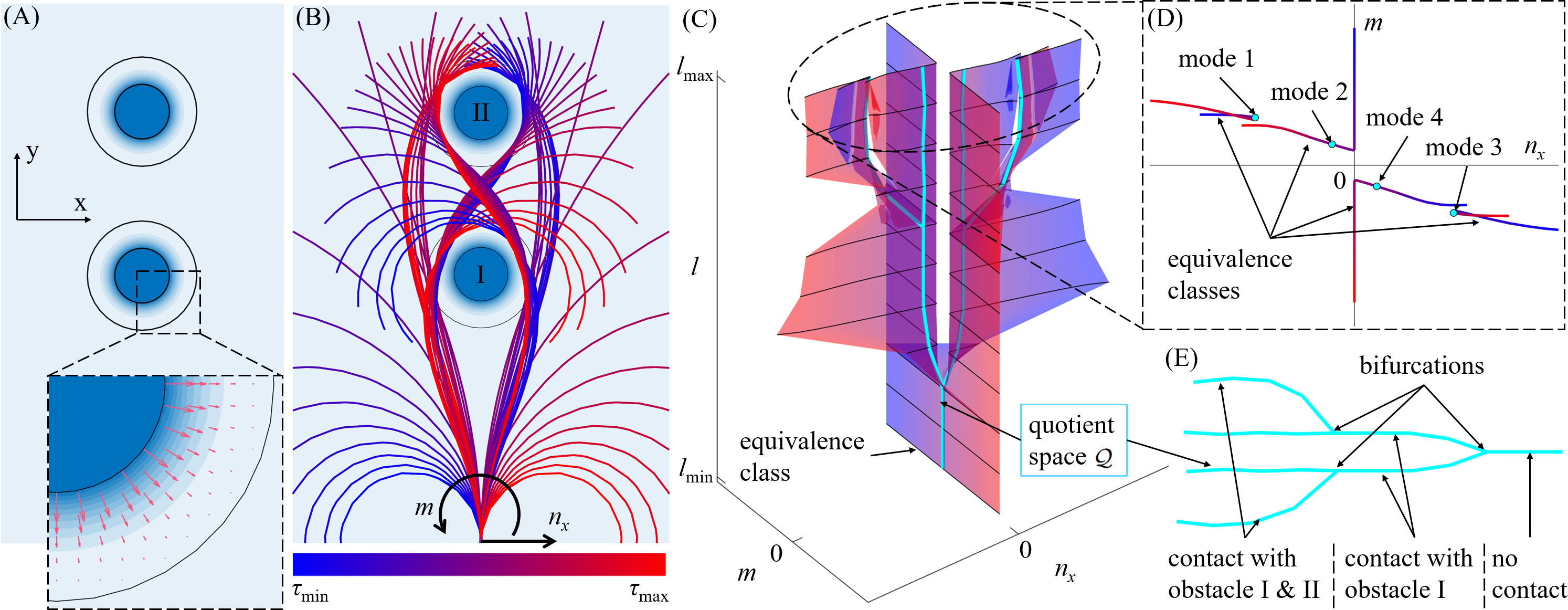
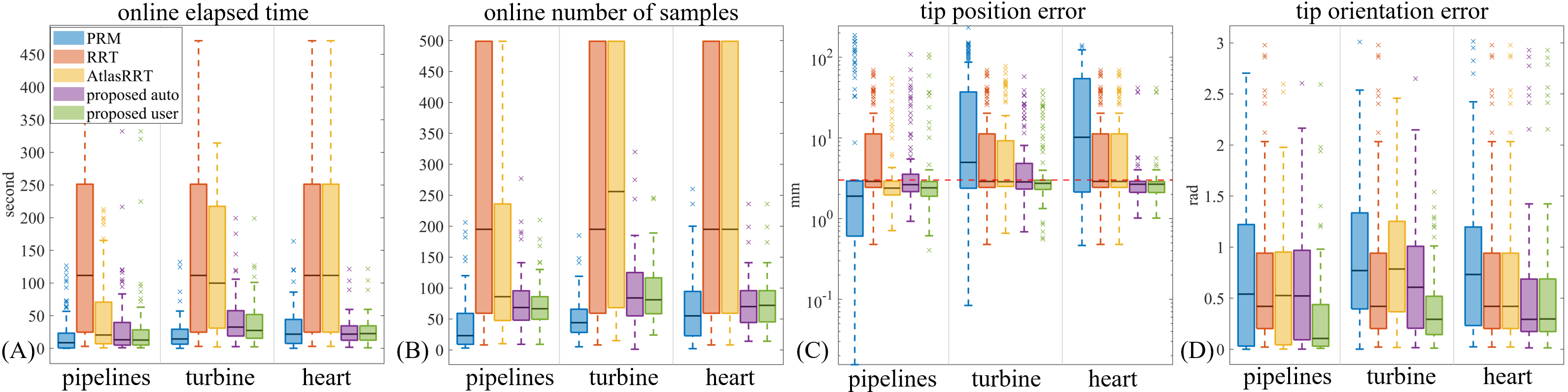
I developed an algorithm to automatically construct this quotient space as a graph. The planning algorithm was tested in three complicated 3D environments: pipelines, turbine blades, and inside a heart. The computation time and success rate are significantly improved over baselines.